
Middlesex Projected and Actual Release
Massachusetts uses several date concepts. The DOC handbook defines a Projected Release Date as an estimate based on credits already earned or expected to be earned. It can move when credits are earned, lost, or recalculated. Earliest Release Date, or ERD, is the earliest point at which release may be allowed after parole eligibility and applicable deductions. ERD Max is a related calculation based on the controlling maximum date and specified deductions. A commitment-time Release Date under state regulations is calculated from sentence terms without future deductions. None of these terms should be treated as the actual physical exit time.
A pretrial detainee usually has no sentence-based Middlesex County inmate release date. Bail, dismissal, a release order, dangerousness proceedings, or later sentencing controls that person's exit. A sentenced house-of-correction or state-prison person has a sentence framework, but credits, other sentences, holds, parole action, and new court orders can alter the result.
The “as of” date matters. A projection made before a new program credit, discipline decision, or sentence correction may be accurate for that earlier day and wrong now. The most useful record identifies the sentence terms, jail credit, earned deductions, controlling minimum and maximum, and calculation date. Compare those fields with the court docket. If the records conflict, ask the custodian to explain its current calculation rather than selecting the earlier or more favorable date.
Scheduled versus actual: A projected date estimates when custody may end. The Certificate of Discharge/Release or equivalent custodian record documents what actually occurred.
Find a Middlesex Inmate Release Date
The public Massachusetts prison locator is designed to find a person currently housed in a DOC facility through VINE. It requires a full first and last name or commitment number. Official sources do not verify that it shows a person-level Projected Release Date, ERD, or ERD Max. An absent result does not prove release. It can mean a spelling mismatch, transfer, a county rather than state custodian, or another system limit.
The official Massachusetts prison locator page shows the current-custody route and its coverage limit.
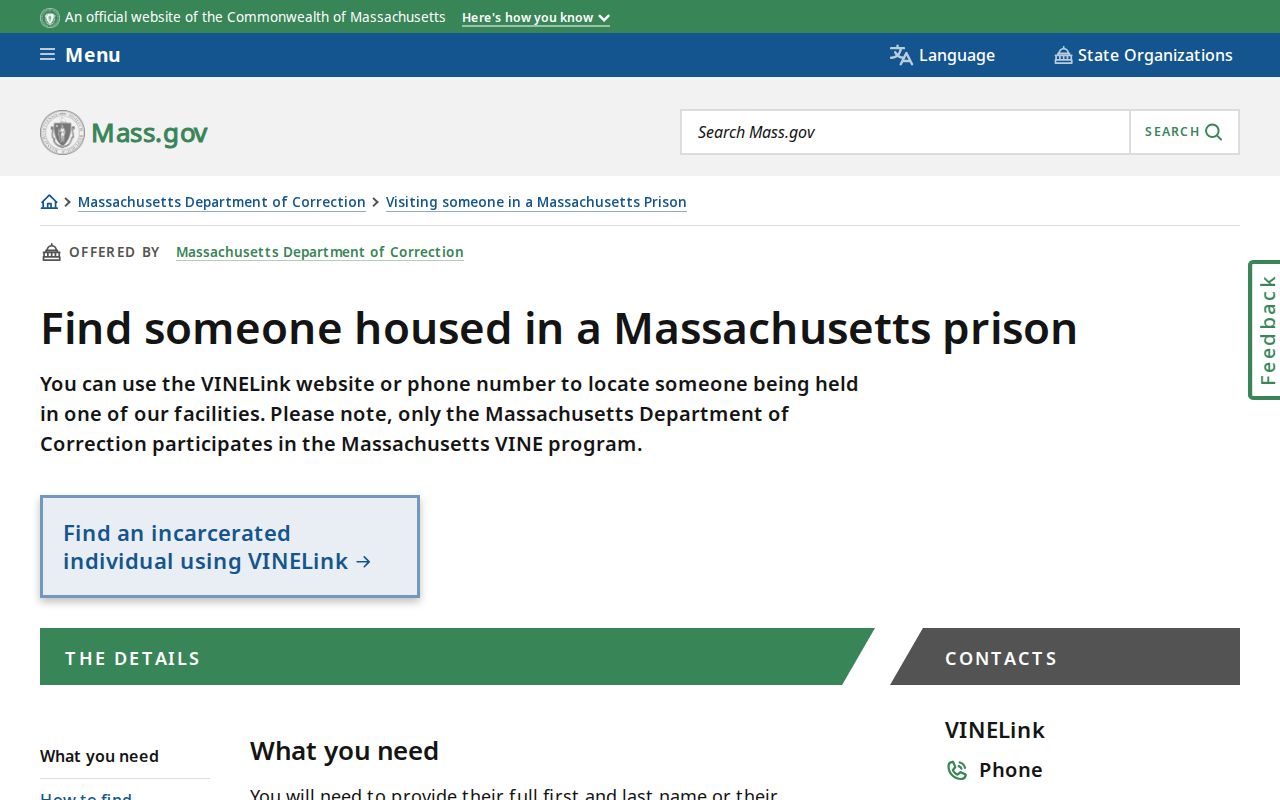
The pictured route can establish that a matching person is shown in participating DOC custody, but it does not replace a date-computation record.
- Identify whether the person is pretrial, serving a house-of-correction sentence, or serving a state-prison sentence.
- Obtain the mittimus, which is the court's written commitment order, plus the sentence and jail-credit details.
- For a county sentence, ask the Middlesex Sheriff's records office for the sentence date and credit record.
- For a state sentence, request the DOC sentence listing and date-computation record.
- Ask for the calculation's current “as of” date because later credit changes can move the estimate.
- Confirm the gate event separately through the custodian's release or discharge record.
The full named-person custody and durable-record sequence also appears on the Middlesex County release search.
Middlesex Release Date Records
For a Middlesex Jail & House of Correction sentence, request existing records from the Sheriff's Records Access Officer at publicrecords@sdm.state.ma.us or 781-960-2830. Ask for the sentence-credit record, release authorization, release date and time, release type, and receiving agency if the person transferred. A transfer to MA DOC, ICE, another jail, or another jurisdiction is not a community release.
For a state-prison sentence, use the DOC public-record request route or doc.rao@state.ma.us. The focused request should name the Certificate of Discharge/Release, sentence listing, date computation, actual physical release date, release type, and destination. DOC records do not cover a county-jail release.
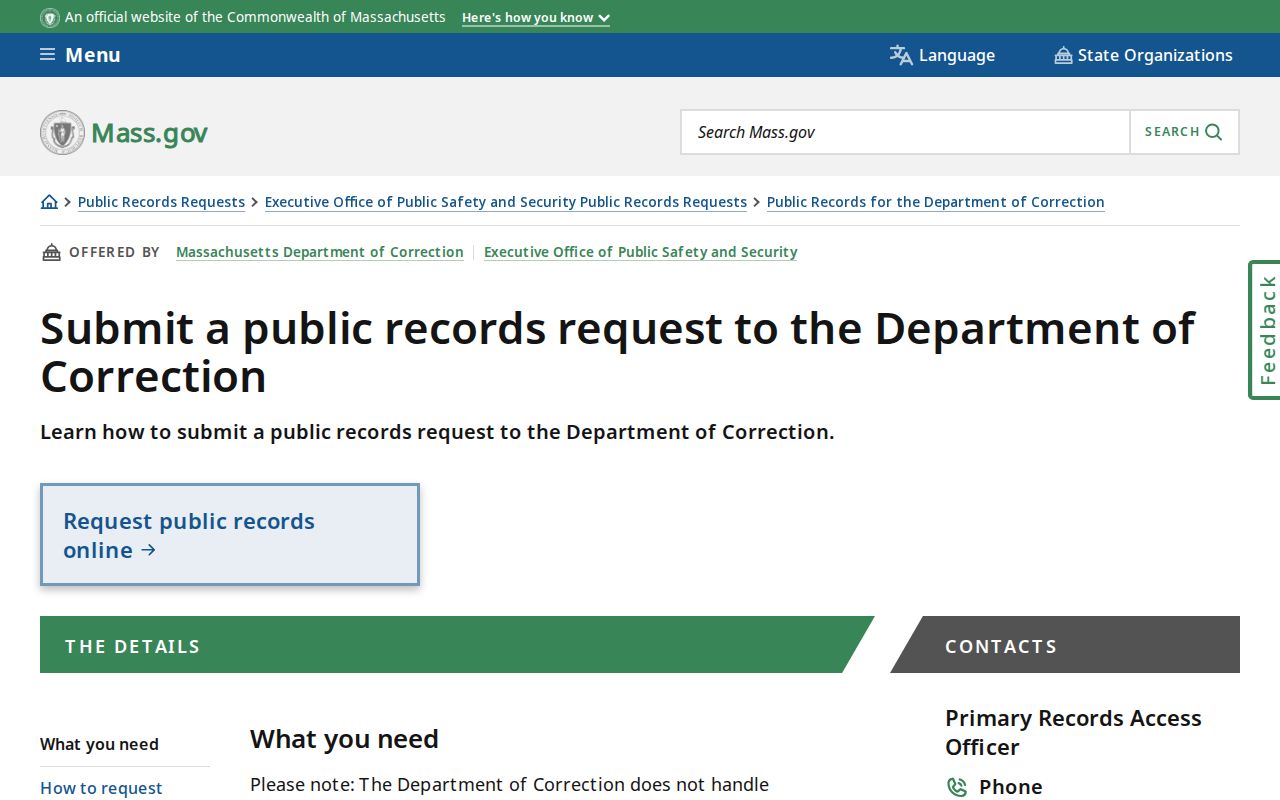
The DOC request page shown above is the durable fallback when the live locator does not supply the needed historical or calculation field.
Under M.G.L. c.66, §10, a Records Access Officer must respond within ten business days to a reasonably described request for records the office holds. That first response may provide records or explain production, exemptions, cost, and appeal rights. A narrow request with the full name, date of birth, commitment or booking number, and custody dates reduces search work.
State agencies ordinarily receive four free labor hours before qualifying labor can be charged, with the usual statutory cap of $25 per hour unless a higher rate is authorized. Black-and-white copies are capped at five cents per page. Electronic date records may avoid copy charges, but an office can still assess permitted search or redaction work. Ask for an itemized estimate and reasonably segregable portions. A written request also creates the record needed for an appeal to the Supervisor of Records.
Middlesex Earned-Time Release Calculations
Massachusetts has no universal rule that every prisoner serves about 85 percent of the sentence. The truth-in-sentencing changes for offenses after June 30, 1994 made the court-imposed minimum the core state-prison parole-eligibility point, subject to current earned-credit law. Federal shorthand should not be imported into a Middlesex County projected release date.
M.G.L. c.127, §129D sets distinct deductions. A state-prison sentence may receive up to 7.5 days per qualifying program or activity each month, with a 15-day monthly maximum. A house-of-correction sentence may receive up to five days per program or activity each month, with a ten-day monthly maximum. Successful completion of a designated program may support added credit under the statute. State-prison completion credits have separate limits, and the combined deductions cannot reduce an imposed maximum or minimum by more than the statute permits.
Credits are not automatic. Agency findings, program completion, sentence type, exclusions, and later forfeiture all matter. Section 129B separately gives day-for-day credit for confinement awaiting trial unless the sentencing court already credited that period. Section 129C concerns a narrower prison-camp conduct credit. The calculation record, not an informal percentage estimate, is the sound source.
Section 129D also permits up to ten additional days for successful completion of a designated program. For a house-of-correction term, that award requires completion of a program calling for six months of satisfactory participation. A state prisoner may receive up to 80 completion-credit days for a designated activity, with aggregate completion credits limited to 17.5 percent of the imposed maximum. The statute also limits combined applicable deductions so they cannot reduce the imposed maximum or minimum by more than 35 percent under its terms.
- Jail credit
- Credit for qualifying time already spent confined before sentence.
- Earned deduction
- A statutory sentence reduction based on qualifying programs or activities.
- Controlling maximum
- The sentence date that governs after multiple sentence rules are applied.
- Detainer
- A request or notice from another authority that may affect the next custodian.
Note: Earned-time limits differ for a state-prison sentence and a house-of-correction sentence, so the same formula cannot be used for both.
Middlesex Parole Eligibility Dates
Parole eligibility is not a scheduled release date. Under 120 CMR 200.02, a house-of-correction sentence or aggregate of at least 60 days is generally eligible at one-half of the aggregate term or two years, whichever is shorter, unless a longer aggregate mandatory minimum controls. State-prison eligibility generally follows the court-imposed minimum less applicable credits. Concurrent and consecutive sentences require their own statutory calculation.
Eligibility allows consideration by the Massachusetts Parole Board. It does not require a grant. A hearing may end in grant, denial, postponement, a review interval, or later rescission. Even a favorable decision is not the release record. The practical Middlesex County inmate release date must be paired with the jail or DOC discharge record. If parole supervision begins, the date on which parole later terminates is yet another event.
Why Middlesex Release Dates Change
A projected date is a live calculation. DOC's Central Date Computation Unit processes sentence calculations and Certificates of Discharge/Release. A corrected mittimus, newly posted jail credit, or later agency action can change the projected result. An internal upcoming-release list is not a public Middlesex County release roster.
| Factor | Effect on the date | Record to verify |
|---|---|---|
| Earned or forfeited credit | Moves the projection under the applicable statute | Current sentence computation |
| Jail-credit correction | Changes time already credited | Court mittimus and custodian calculation |
| Consecutive sentence | Adds another controlling term | Sentence listing and docket |
| Detainer or other custodian | May prevent return to the community | Release destination and receiving-agency record |
| Parole grant or rescission | Can create or withdraw a planned release | Parole Board decision and discharge record |
| Later court order | Can change confinement or sentence terms | Updated criminal docket |
In 2026, DOC announced a tablet tool that shows updated release timelines, including maximum and release-to-supervision dates, to incarcerated people on DOC-issued tablets. It is not a public person search. Family or other permitted contacts still need the official records route.
Middlesex Weekend Release Date Rule
Massachusetts has a concrete sentence-expiration rule that can move a date. When a term expires on Saturday, Sunday, or a legal holiday, M.G.L. c.127, §150 directs discharge on the preceding day. This rule applies to expiration of the term. It does not govern every bail release, parole event, transfer, dismissal, or court-ordered exit.
The official §150 page presents the preceding-day rule directly.
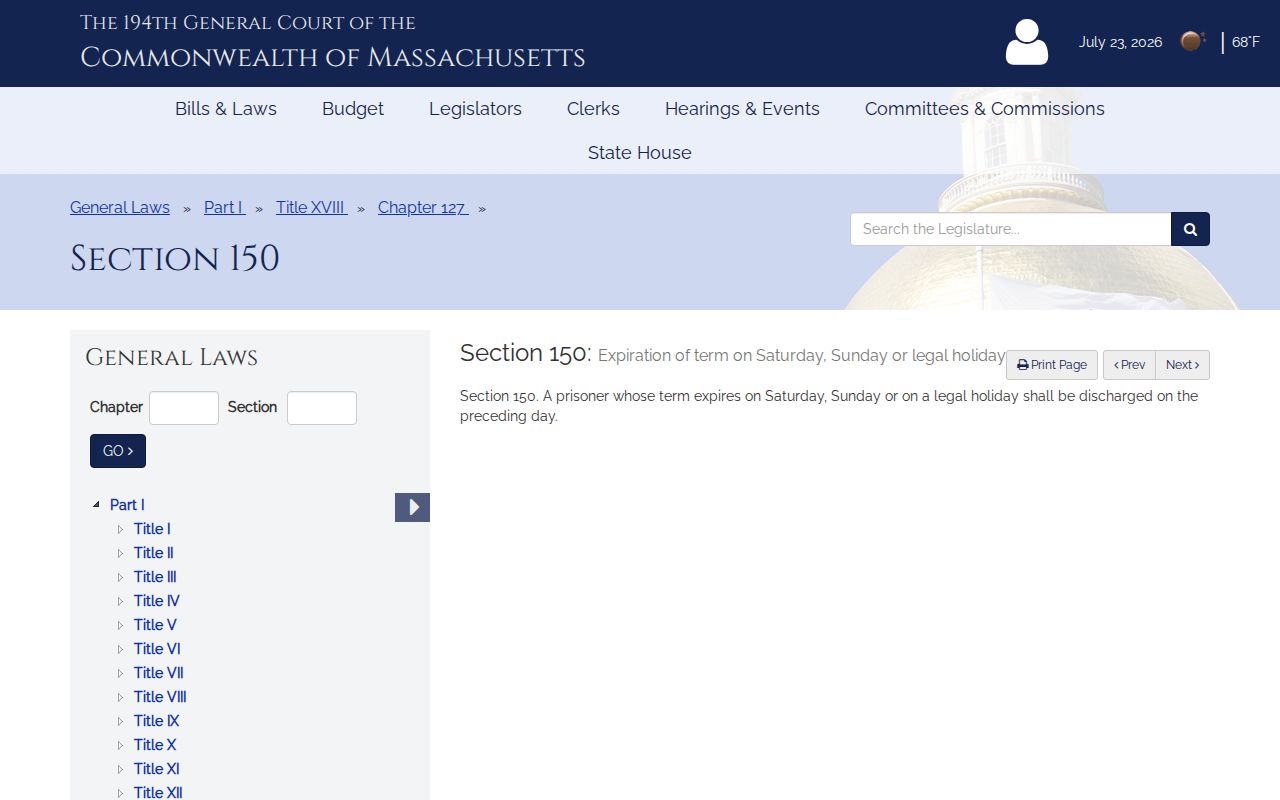
The statute shown provides a firm Massachusetts timing rule, but the custodian's discharge record remains necessary to confirm the actual exit.
Note: The preceding-day rule applies to sentence expiration, not every parole, bail, court, or transfer event.
Confirm a Middlesex Release Date
A lawful notification can report that a release event occurred, while a projected date remains only an estimate. Massachusetts VINE currently covers Massachusetts DOC participation, not the Middlesex Jail & House of Correction. A DOC person can be searched by full name or commitment number, and notification options can be registered where the exact record permits them. The Middlesex VINELink release check explains that limited channel.
Use the custodian that actually held the person. MSO records govern a Billerica county release. DOC records govern a state-prison discharge. BOP handles FMC Devens and other federal custody. ICE uses its own locator for a limited recent-release period. Court records can explain the legal order, but they may not state the physical exit time or receiving authority. The last step is always to compare the projected figure with the actual release or transfer record.
Note: A transfer ends custody at one facility but does not prove the person returned to the community.