
Middlesex 72-Hour Release Status
No official Middlesex Sheriff's Office page naming people released during a rolling 72-hour window was identified as of July 23, 2026. The official-site review found no public current-custody name lookup, three-day release roster, booking-photo list, or Sheriff jail-information app. The absence of a web feed does not mean the Sheriff's Office lacks a release record. It means the public cannot honestly be directed to a live page that was not found.
A three-day question should be framed as a date-range records inquiry. Specify the start and end dates, the person when known, the actual release date and time, the legal release type, and the destination or receiving authority. These details matter more than a simple “released” label. A person may leave the Middlesex Jail & House of Correction for MA DOC, ICE, another jail, or another jurisdiction without returning to the community.
Check Middlesex Three-Day Releases
Start with the last agency that held the person. For a county-jail stay, the Middlesex Jail & House of Correction is the source for the physical custody event. Court eAccess can explain the order behind bail, dismissal, sentencing, or another disposition, but a docket may not show the hour when jail processing ended. The records path closes that gap.
- Set an exact three-day range, including full calendar dates rather than “this weekend.”
- Identify the person by full name, aliases, date of birth, and booking or agency number when known.
- Call the jail at 978-667-1711 to ask whether the person remains in Middlesex custody.
- Use the MSO public-records process to request the actual release time, type, facility, and destination.
- Compare the result with the criminal docket and any receiving-agency record before describing the event as community release.
This is a wider-window process, not a substitute for a named-person search across every system. If the inquiry concerns only today, the Middlesex County released-last-24-hours method narrows the request and highlights same-day bail processing.
Note: A three-day request with exact dates is easier to search and less likely to mix separate admissions or release events.
Middlesex 72-Hour Record Fields
There is no official three-day display whose columns can be copied into a public field list. The useful fields are instead those that should appear in a targeted request. They show who the record concerns, when the custody event occurred, and whether another agency received the person.
| Requested Field | Why It Matters |
|---|---|
| Name, aliases, and date of birth | Separates people with similar names and supports an accurate records search. |
| Booking, PCF, SID, or OBTN | Links the person to the correct jail and administrative record. |
| Admission date range | Prevents an older jail stay from being confused with the three-day period. |
| Actual release date and time | Identifies the physical exit from Middlesex custody. |
| Release type or legal reason | Separates bail, court order, sentence expiration, parole, transfer, death, or another outcome. |
| Destination or receiving agency | Shows whether the person went home or remained in another authority's custody. |
| Release authorization | Points to the certificate, court order, or equivalent basis for the event. |
Massachusetts distinguishes a calculated release date, physical release, actual release from the full sentence, parole release, and transfer. Those dates may not match. A pretrial detainee also lacks the sentence-completion date that may exist for a sentenced person. Within a 72-hour review, the physical timestamp and destination are the strongest way to describe what happened.
Requesting the booking or admission sheet with the release authorization can resolve a second problem: repeated custody events. The same person may have more than one admission, court trip, transfer, or release in the records. A narrow admission range and agency number keep the requested three-day exit tied to the correct stay. If the person served a sentence, sentence length, jail credit, and earned-time fields may explain the timing, but they should not be substituted for the actual release date and time.
Middlesex Weekend Release Timing
Massachusetts law has one specific rule that can affect a weekend or holiday range. Under M.G.L. c.127, §150, when a term expires on a Saturday, Sunday, or legal holiday, discharge occurs on the preceding day. This is a sentence-expiration rule. It does not control every bail release, parole event, transfer, court order, or immigration handoff.
That distinction is vital when reviewing three calendar days. A Friday discharge may reflect a term that would otherwise expire on the weekend, yet a Saturday bail payment follows a different route. The Sheriff's bail page allows a poster to arrive during its listed evening window every day, but the page gives no guaranteed physical discharge time. An online three-day roster would not resolve these legal differences even if one existed.
The official statute page shows the preceding-day sentence-expiration rule.
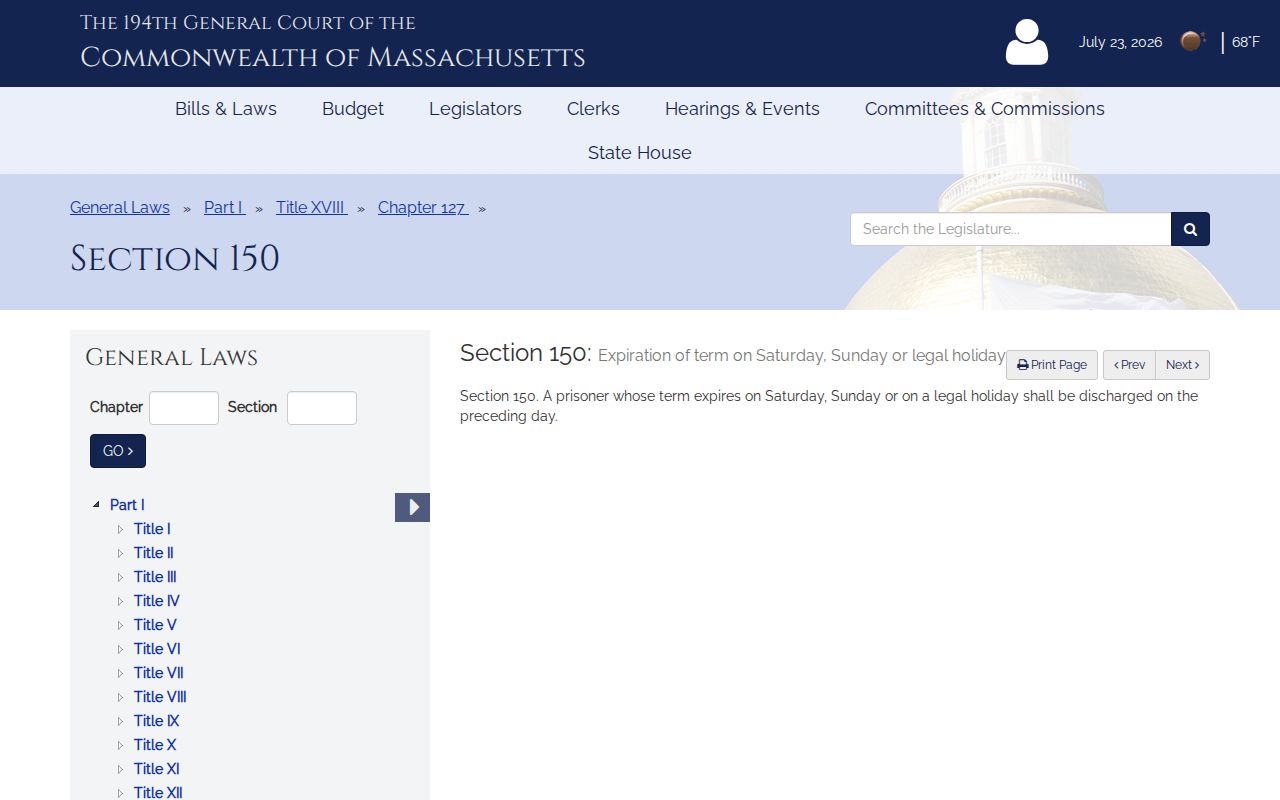
The captured law explains one possible shift in the three-day window. It should not be generalized to every type of release from Middlesex custody.
Middlesex Historical Release Rows
The official Chapter 126 quarterly report is the closest public local release-row archive identified. It is delayed, anonymous, and designed for reporting rather than a live three-day search. The report can show that release events were recorded during a past quarter. It cannot tell the public which named person left over a weekend.
| Quarterly Field | Present? | Three-Day Use |
|---|---|---|
| Release date | Yes | Historical event date only |
| Earned time, sentence length, jail credit | Yes | Sentence context without a public name |
| PCF, SID, OBTN | Yes | Administrative identifiers |
| Name and photograph | No | Cannot identify a person |
| Release time and reason | No | Cannot establish hour or legal type |
| Destination | No | Cannot prove return to the community |
This local data quirk is why the quarterly archive must not be styled as a 72-hour feed. A historical row may represent release from one custodian to another. Without a name, time, reason, or destination, it cannot answer the central personal question.
Formal records can outlive a public custody screen by years. The statewide retention schedule includes Middlesex Sheriff commitment and discharge logs and indexes among the records preserved electronically. Other central case records and property records have separate retention rules. This does not make every field automatically open, but it makes a records request materially different from checking a roster. A missing live entry says little about whether the underlying three-day event can still be documented.
The Middlesex Sheriff's official navigation provides visual context for the current lack of a release-roster route.
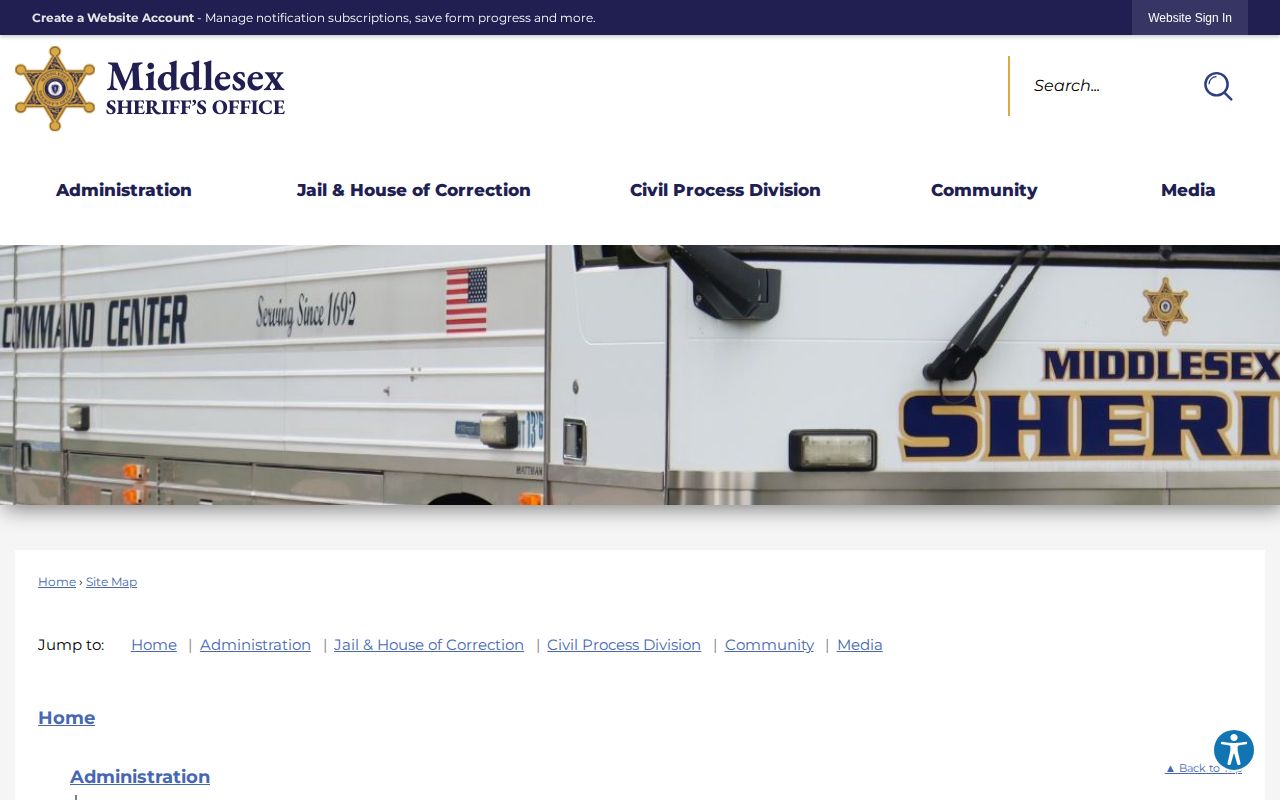
The navigation capture supports the official-site sweep. The individual release record remains available through the records process even when no public feed is listed.
Note: Anonymous quarterly rows preserve useful trend data, but they cannot resolve a named Middlesex County release during a weekend.
Middlesex Release Agency Fallbacks
The records request belongs with the agency that last had custody. Sending a county-jail request to MA DOC can produce delay or a no-record answer because the state department expressly separates county jail and house-of-correction records from its own. The same rule applies to federal and immigration custody.
- County jail release
- Call Middlesex Jail/HOC and use the MSO records route for the booking and release record.
- State-prison event
- Use Massachusetts VINE for current MA DOC custody, then request DOC discharge documentation for the historical result.
- Federal release
- Use the BOP Inmate Locator for FMC Devens or another federal prison. “Released” ends BOP custody, not every later obligation.
- ICE transfer
- Use the ICE locator. Leaving the county jail for immigration custody is a jurisdiction change, not release home.
- Court disposition
- Use the exact criminal docket to understand the legal order, then confirm the custody timestamp with the jail or prison.
Massachusetts VINE should not be described as a Middlesex Jail/HOC release list. The current state page says only MA DOC participates. A person transferred from Billerica into MA DOC may become visible there, but that new record is evidence of continued state custody, not a community discharge.
Municipal police lockups are another boundary. Middlesex County has many local arrest-processing sites, but those short-term holding places are not county correctional facilities or three-day historical archives. The arresting agency and court may help identify where the person went next. Once the person reaches the Middlesex jail, a state prison, or a federal facility, the record request must follow that custodian.
Read Middlesex Release Gaps Carefully
A missing name can reflect spelling, an alias, a different identifier, another jurisdiction, sealing, record age, data lag, or transfer. None proves that the person returned home. Positive proof comes from a release or discharge record with the type and destination, or from the relevant agency's result interpreted within its stated scope.
For a known person whose path may cross several systems, the Middlesex County released inmate lookup organizes the county, DOC, court, federal, and ICE routes. For the 72-hour question itself, keep the range exact and ask what happened at the end of Middlesex custody. That wording makes the response useful even when the answer is transfer rather than release.
Note: Date-stamp each source checked because custody status can change more than once within the same three-day interval.