
Middlesex Parole and Probation Compared
Parole is conditional release from a sentence while the Massachusetts Parole Board keeps jurisdiction. Probation comes from a court. It may be the sentence itself or may follow a jail or prison term. The Massachusetts Probation Service and the sentencing court administer it. A person can finish custody without parole. Someone else may serve probation without ever entering prison. That is why disappearance from the Middlesex Jail & House of Correction roster, even if a roster were available, could not identify the supervision type.
The key dates also differ. A physical release date marks the end of that custody event. A parole or probation termination date marks the end of supervision. Sentence expiration may occur later still. The Middlesex County released-inmate search and records path is the better route for proving the gate event, while court and Parole Board records address ongoing control.
| Point | Parole | Probation |
|---|---|---|
| Source | Conditional release under Parole Board jurisdiction | Court sentence or court-ordered period |
| Record holder | Massachusetts Parole Board | Sentencing court and Massachusetts Probation Service |
| Public check | Limited Board records, court docket, and authorized request | Public docket and the sentencing court clerk or probation office |
| End point | Termination, sentence expiration, or another Board action | Discharge, termination, or completion shown by the court record |
- Parole
- Conditional community release before all sentence jurisdiction has ended.
- Probation
- Court supervision imposed instead of, or after, incarceration.
- Discharge
- The documented end of custody or supervision, depending on the record.
- Absconder
- A supervised person alleged to have stopped reporting or left supervision without permission.
Verify Middlesex Post-Release Supervision
No official statewide public name search covers all Massachusetts parolees or probationers. Verification therefore begins with the criminal case, not a generic people search. Most remote Massachusetts criminal docket searches require the exact docket number. The docket may show the sentence, probation order, later violation event, revocation, termination, or discharge. A clerk can help route a request when the court and case number are known.
Parole records have another limit. A third party generally needs the parolee's authorization and the required authorization or CORI release to obtain an individual parole record. Public life-sentence Records of Decision are a narrower exception. Those named decisions can show a grant, denial, reasons, votes, and review timing, but a grant is not proof that the person left on the expected day.
- Locate the criminal docket and read the sentence, probation terms, and later events.
- For a life case, check the official named Records of Decision and monthly hearing material.
- For other individual parole records, obtain the person's authorization when the Board requires it.
- Use the Parole Board directory to confirm the correct regional office before assuming Region 6 has the case.
- For probation, contact the sentencing court with the docket number and ask for the public record of termination, revocation, or discharge.
- Confirm the earlier physical release with the jail or DOC because supervision records answer a separate question.
Note: Date-stamp every status check because release, a later violation warrant, return to custody, and final discharge can occur at different times.
Middlesex Parole Region 6
Parole Region 6 operates within the Lowell Community Justice Center. Its location is useful for Middlesex routing, but the published office page does not prove that every address in the county belongs to Region 6. Confirm assignment through the Board directory or central office. Probation is not housed in one countywide office. It remains tied to the sentencing court, including Middlesex Superior Court and the District Courts serving communities such as Lowell, Framingham, and Woburn.
The official Parole Region 6 page shows the regional location and contact details pictured below.
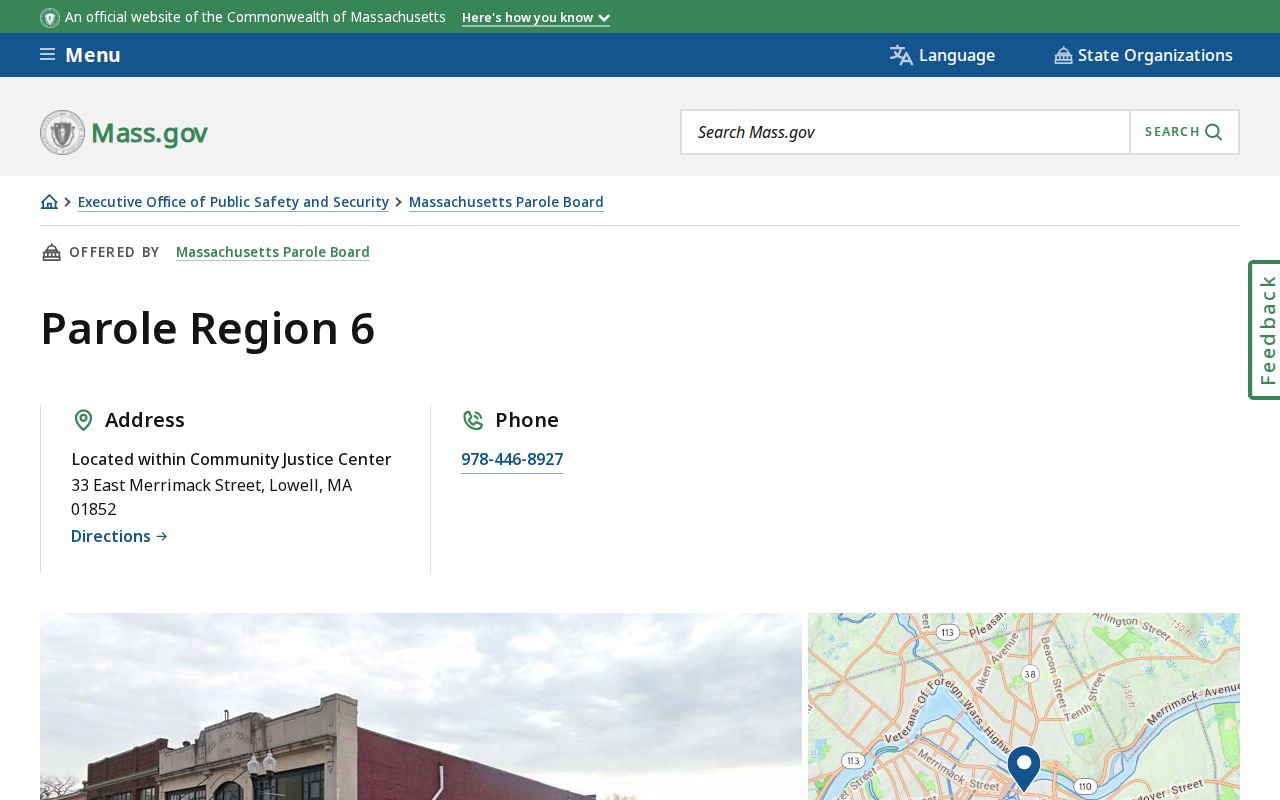
The image helps confirm the Lowell office, but an office listing is not a public person-level supervision result.
Parole Region 6
Community Justice Center
33 East Merrimack Street
Lowell, MA 01852
978-446-8927
Monday through Friday, 9 a.m. to 5 p.m.
Massachusetts Parole Board
12 Mercer Road
Natick, MA 01760
508-650-4500 or 866-480-6272
Monday through Friday, 8:45 a.m. to 5 p.m.
Middlesex probation contacts depend on the court. Middlesex County Superior Court in Woburn lists its Clerk's Office and Probation Department at 781-939-2700, with weekday hours from 8:30 a.m. to 4:30 p.m. Lowell District Court lists 978-459-4101 for the Clerk's Office and Probation Department. Framingham District Court lists Probation at 508-875-5241, while Woburn District Court lists 781-935-4000. Give the office the exact docket number. Staff may route a public-record question, but the office listing alone cannot prove that a named person remains under supervision.
Middlesex Parole Hearing Records
The Massachusetts Parole Hearings hub divides institutional, life-sentence, victim-access, and termination proceedings. Ordinary institutional hearings for DOC or house-of-correction release, rescission, and revocation are closed. The Transitional Services Unit schedules those proceedings and tracks eligibility and discharge dates. Public life-sentence hearings follow a different process.
The Board publishes a monthly Life Sentence Hearing Calendar. It lists the hearing date and time, the person's name, whether the matter is an initial or review hearing, and postponement information when applicable.
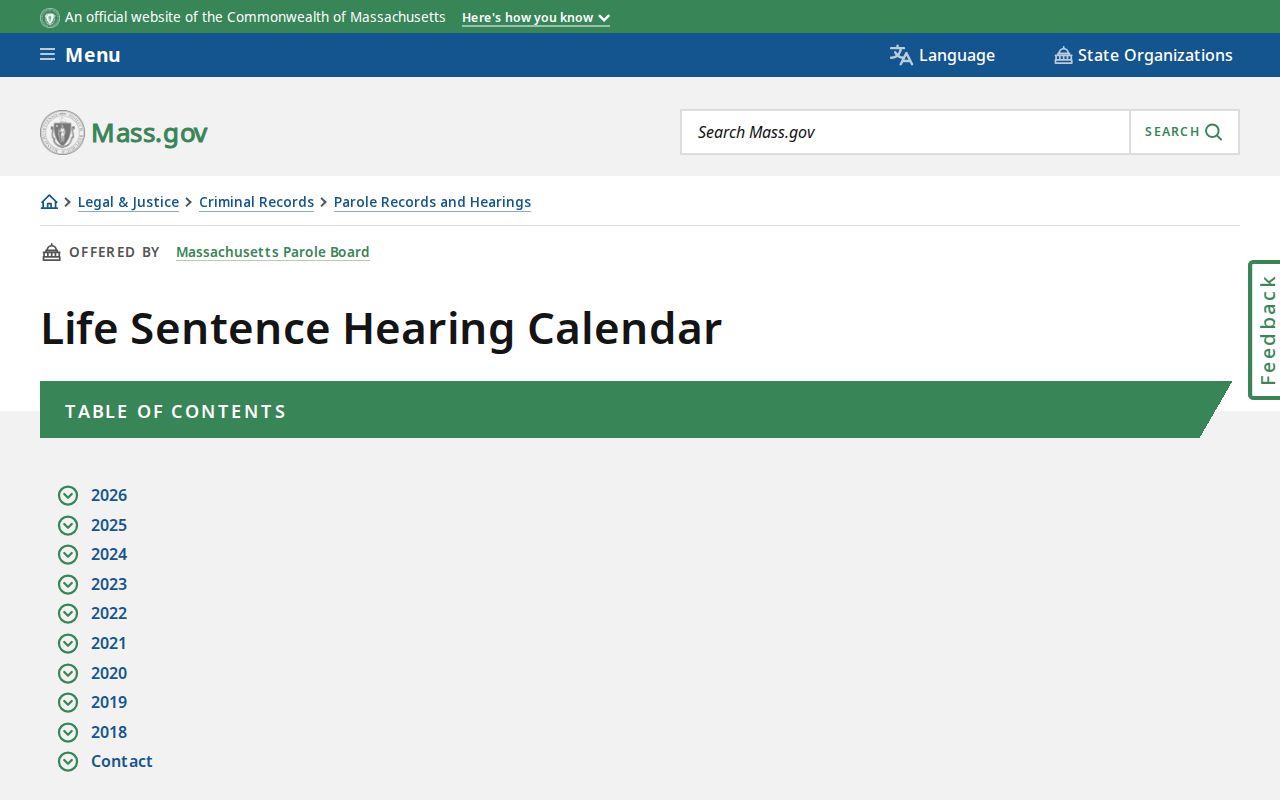
This calendar proves a hearing was scheduled, not that Middlesex County parole release occurred. The named Record of Decision should be read next, then paired with the DOC or house-of-correction discharge record.
Possible outcomes include grant, denial, postponement, a new review interval, rescission of a set parole date, revocation after community release, warning, modification, or termination. Eligibility is only the point at which the Board may consider release. Even a grant may later change before the gate event.
For state sentences, M.G.L. c.127, §133 generally ties parole eligibility to the court-imposed minimum after applicable earned deductions. House-of-correction calculations follow the Board's separate regulatory formula. Life-sentence matters have additional rules under §133A. Those rules explain when review can begin, not when Middlesex County release must occur. The Board must still reach the findings required by law, and DOC or the house of correction must document any later physical exit.
Middlesex Parole Warrants and Violations
A parole warrant changes the meaning of a past release. The person may have physically left prison and later returned to custody on an alleged violation. Board materials distinguish temporary warrants from permanent custody warrants. No public searchable statewide list of every parole absconder was identified. The official wanted-parolee page is a tip route, not a full person lookup.
The Parole Board Warrant Apprehension Unit accepts information at 617-376-6269, and Massachusetts State Police Dispatch uses 508-820-2121. That route must not be confused with the DOC Most Wanted list, which concerns escapees from DOC custody. A probation warrant is documented through the sentencing court and case docket. Court or Board records should support any statement about current warrant status.
A prior Middlesex County release does not prove current community status. A later warrant, revocation, or transfer may have returned the person to custody.
Middlesex Supervision Discharge Records
Parole termination, probation completion, sentence expiration, and physical release can each have a separate date. An eligible parolee may apply for early termination after meeting the Board's published standards. Those standards include a satisfactory period on parole, the required supervision or risk status, and no recent warning, violation report, warrant, or open case. The Board may deny the request, terminate without a hearing, or grant a public termination hearing.
Compliance credits can affect the end of supervision, not the original prison exit. M.G.L. c.127, §130C allows qualifying state-prison parolees up to 15 days per month for satisfactory conduct, subject to exclusions and rescission. M.G.L. c.276, §87B provides a separate probation-credit framework for an eligible sentence that includes incarceration followed by probation. A docket or Board termination record is the durable proof that supervision ended.
Middlesex Reentry and Supervision Centers
Middlesex has a local transition system that can look like community supervision but includes both custody and noncustody settings. The Sheriff's Women's Pre-Release Center opened in 2021, and the Older Adult Re-Entry Unit opened in 2024 for men age 55 and older. Both are in-custody transition units. Placement there is not a release or parole discharge.
After a person enters the community, Massachusetts Community Justice Support Centers operate in Framingham, Lowell, and Woburn. They are run through the Probation Service and Office of Community Corrections. The Lowell center shares a site with Parole Region 6, but that does not merge parole and probation authority. Each agency keeps its own records and rules.
- Framingham center: 298 Howard Street, 508-975-4849
- Lowell center: 33 East Merrimack Street, 978-596-0836
- Woburn center: Tower Office Park, Suite 55, 781-281-0803
Note: Pre-release placement remains custody, while a Community Justice Support Center serves people who are already in the community.
Property After Middlesex Release
Supervision status does not settle property or account issues from the jail stay. The Middlesex Sheriff's Office mails remaining account funds as a check after the former person contacts the Canteen Department. The funds cannot be picked up in person. Property collection requires an appointment with at least 24 hours' notice.
The former person may collect the property, or a specifically documented designee may do so. These post-release tasks are separate from parole reporting, probation appointments, and discharge records. They also show why the end of custody can create several distinct follow-up dates. A parole or probation office cannot replace the Sheriff's property process, and a property appointment does not prove that supervision ended.
Note: The Sheriff's property and Canteen contacts cannot verify a parole assignment, probation term, or final supervision discharge.